Why go beyond the main streets
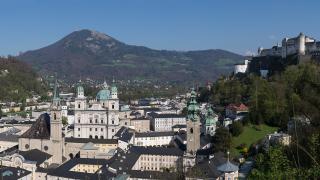
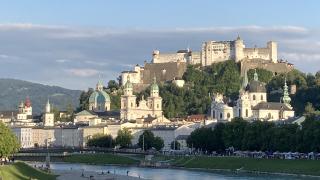
Most visitors to Salzburg follow the same line: Mirabell Gardens, across the Makartsteg bridge, along Getreidegasse to Mozart's Birthplace, then up to the fortress. Those sights are worth seeing, but the old town also has a network of covered passages, side lanes and hill paths that are much quieter and say a lot about how the city was built. This walk links them in a loop of a few hours, mostly on foot and with one optional lift ride.
The through-house passages off Getreidegasse
Getreidegasse is lined with tall, narrow merchant houses. Because the houses were built so closely together, cross-connections between streets were nearly impossible, which was bad for trade. The solution was the Durchhäuser: public passages that run straight through privately owned townhouses, linking Getreidegasse with the parallel streets and squares behind. Many still have arcaded courtyards and galleries, and today they hold small shops and cafés.
The best known runs from Getreidegasse 3 to Universitätsplatz. Look for the relief of the Madonna and Child in a dark niche, and for the whale rib hung in the passage, a reminder of Salzburg merchants' long-distance trade links. As you walk through other passages, look up at the house fronts and doorways: older houses carry date stones, the names of former owners and the Eye of God symbol.
Universitätsplatz itself hosts a fruit and vegetable market (the Grünmarkt) and sits behind the Kollegienkirche, a large Baroque church designed by Johann Bernhard Fischer von Erlach.
St Peter's: cemetery and catacombs
From Universitätsplatz it is a few minutes' walk to St Peter's Abbey, one of the oldest monasteries in the German-speaking world. Its walled cemetery sits right against the Mönchsberg cliff, with wrought-iron grave crosses and arcaded family tombs. Above the cemetery, chambers and chapels are cut into the rock face; these are known as the catacombs and can be visited for a small fee. The cemetery is an active burial ground, so keep voices down.
Up to Nonnberg Abbey
From the old town, climb the Nonnbergstiege steps below the fortress to Nonnberg Abbey, a Benedictine convent founded around 714 by St Rupert. It is regarded as the oldest continuously existing women's convent in the German-speaking world. The church is open to visitors, and the terrace outside gives a view across the rooftops towards the Kapuzinerberg. Nonnberg is a working convent, so expect much of it to be closed to the public.
Mönchsberg paths
Rather than queuing for the fortress funicular, you can walk up from Nonnberg or the Festungsgasse to the fortress and then continue west along the wooded ridge of the Mönchsberg. Paths run along the top past old fortifications and viewpoints over the old town. At the far end, the Museum der Moderne sits on the cliff edge, and the MönchsbergAufzug lift drops you back down to Gstättengasse in the old town. Walking the ridge in the late afternoon gives you the town in good light without the crowds of the fortress terrace.
Steingasse and the Kapuzinerberg
Cross the Salzach to the right bank and turn into Steingasse, a narrow lane squeezed between the river and the Kapuzinerberg. It was part of an old trade route into the city and is still cobbled, dim and quiet compared with the left bank.
A plaque at Steingasse 9 names it as the birthplace of Joseph Mohr, who wrote the words of Silent Night. The Silent Night Society notes that this is doubtful: his actual birth house is unknown, and a 1794 census only places his family at Steingasse 31. It is still worth reading the plaque, but treat it as tradition rather than fact.
From Steingasse, the Imbergstiege staircase climbs to the Capuchin friary on the Kapuzinerberg. The path continues uphill through woodland to viewpoints over the old town and the fortress, a good alternative to the busier Mönchsberg.
Practical tips
- Timing. The passages and Getreidegasse are busiest from late morning to late afternoon. Early morning or early evening is quieter.
- Footwear. Cobbles, steps and forest paths make flat, grippy shoes worth wearing; the Kapuzinerberg and Nonnberg climbs are short but steep.
- Opening hours. Passage gates, church doors and the catacombs keep their own hours, and some passages close at night. Check on the day if a particular place matters to you.
- Respect private space. The Durchhäuser run through private buildings and the abbeys are working religious houses. Stay on the public routes.
- Salzburg Card. If you plan to use the Mönchsberg lift, the fortress and several museums in one day, the Salzburg Card covers one-time entry to the city's attractions and free city buses.