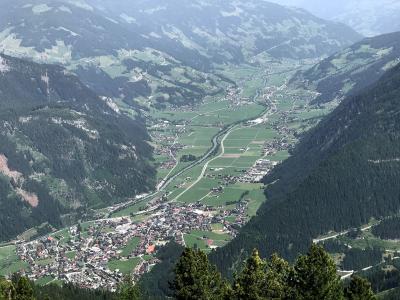
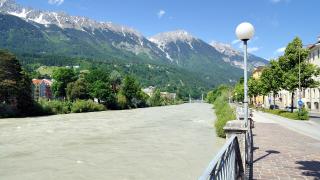
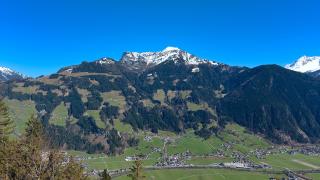
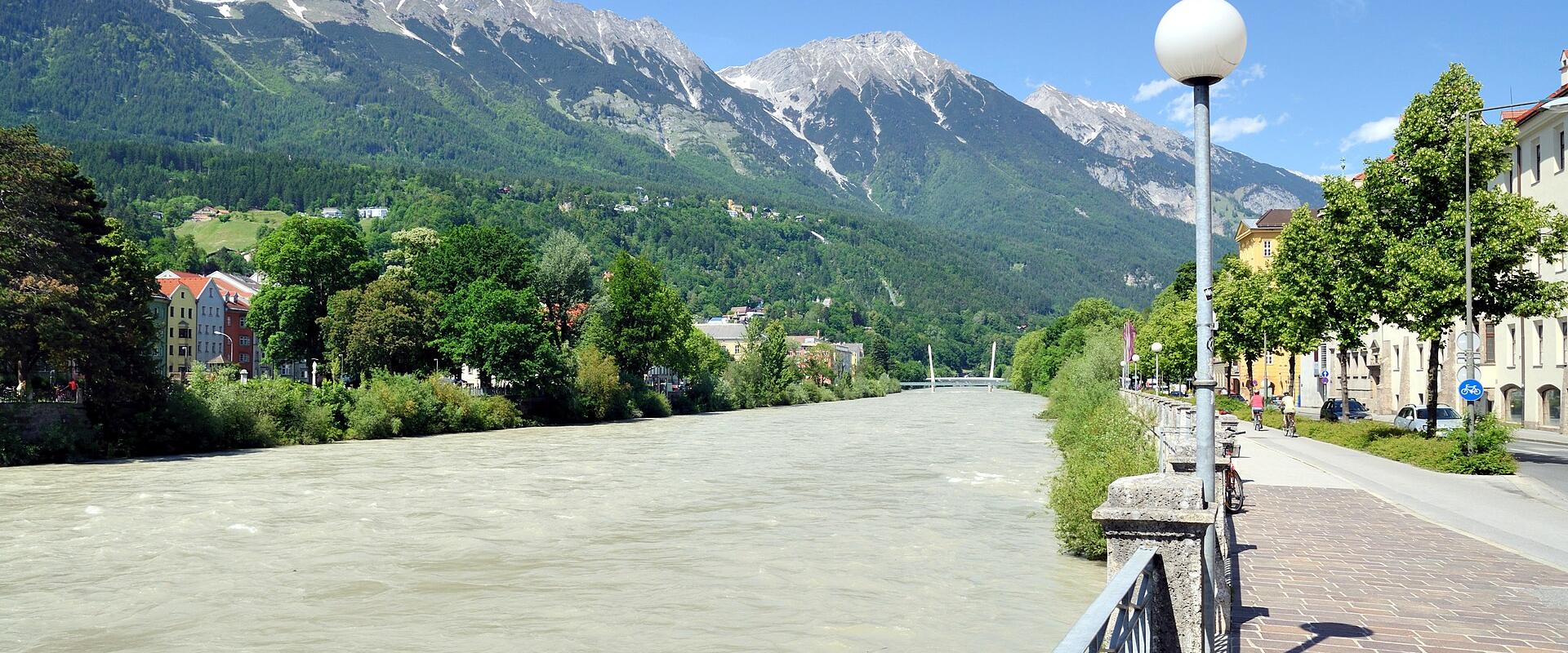
Innsbruck sits in a broad stretch of the Inn Valley, at about 570 metres, with the Nordkette to the north and the Patscherkofel and Serles ranges to the south. The setting is one of the most dramatic of any European city: from the Old Town you can look up at snow-covered peaks over 2,000 metres high. About 132,000 people live in the city, which makes it the fifth largest in Austria, and a large student population gives it energy.
The city's history is that of a crossing and a court. The first settlement grew around a bridge across the Inn, and in 1239 the town received its charter from the Counts of Andechs. In the fifteenth century Duke Frederick IV of Tyrol made Innsbruck his residence, and after 1490 Emperor Maximilian I turned it into a court city of the Habsburg dynasty, a role it kept for generations; the Habsburgs left the Hofburg and other buildings behind.
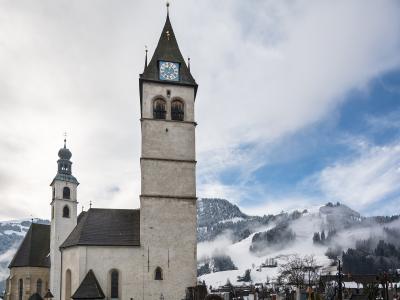
The Old Town, the Altstadt, is small and walkable. The Herzog-Friedrich-Strasse is lined with arcaded houses with oriel windows, and at its centre is the Golden Roof, the Goldenes Dachl, a late Gothic balcony built around 1500 and covered with 2,657 gilded copper tiles. Emperor Maximilian used it to watch tournaments and festivities in the square below, and it is the best-known image of Innsbruck. A museum in the building tells the story. Close by, the parish church, the Dom zu St. Jakob, is a Baroque building of 1717–1724, and the Hofburg, the imperial Palace, houses the Imperial Apartments, rooms in the style of Maria Theresa.
The Hofkirche, the Court Church, is Innsbruck's most remarkable sight. It was built to hold the tomb of Emperor Maximilian I, and the empty cenotaph, a huge marble sarcophagus, is surrounded by 28 oversized bronze statues of ancestors and heroes, known as the Black Men, the Schwarze Mander. Next door, the Tiroler Volkskunstmuseum, the Tyrolean Folk Art Museum, displays rooms, furniture, costumes and crafts from the region. Both can be visited together.
Outside the centre stands Ambras Castle, a Renaissance castle on a hill above the city, where Archduke Ferdinand II of Tyrol built one of the first museums in Europe, a Chamber of Art and Wonders, which can still be seen. Another landmark is the Bergisel ski jump, rebuilt by the architect Zaha Hadid in 2002, with a viewing platform and restaurant. Hadid also designed the stations of the Hungerburgbahn, a funicular with curved glass roofs that climbs from the city to the Nordkette.
The Nordkettenbahn, the Nordkette Cable Car, is an experience in itself: from the Congress station near the old town, it rises in three stages, a funicular and two cable cars, to the Hafelekar at over 2,200 metres, and from the top you look down on the roofs and across the Alps. Trails and climbing routes begin there, and the whole trip takes less than half an hour. The Nordkette is a favourite with locals for hiking, mountain biking and ski touring.
Innsbruck's Olympic history is another theme. The city hosted the Winter Olympics in 1964 and 1976, and the Olympics' legacy includes ski runs at the Axamer Lizum and ice venues in the city. Among the best-known ski areas, the Stubai Glacier, about 40 kilometres away, has a long ski season, from about October to May, and a regional ski pass covers several areas. Summer activities include hiking, paragliding and cycling on the Inn River path. Not far away, in Wattens, the Swarovski Crystal Worlds, an attraction with a giant head with waterfalls in its mouth, was created by the artist André Heller.
Culture continues all year. The University of Innsbruck dominates student life, and the Festival of Early Music in August draws musicians from across Europe, while the Tyrolean State Theatre and other venues offer concerts, and Christmas markets fill the old town from mid-November. Food is Tyrolean: Tiroler Gröstl, Kaspressknödel, Kaiserschmarrn and dumplings in many forms, with local beer and schnapps.
The best time to visit depends on the season. From December to March, skiing is the draw; from May to September, hiking and city sightseeing, with the Festival in August and warm days in July. September and October bring clear, golden views, and the Christmas markets begin in mid-November, running until December.
Getting there is easy. Innsbruck's main station has direct trains from Munich in under two hours, from Vienna in about four and a quarter hours and from Zurich in about three and a half hours. The city's Airport has flights to several European cities, and by road the A12 Inntal Autobahn and the Brenner motorway meet here. The old town is pedestrian, and buses and trams cover the rest.
Best time to visit
Visit from mid-May to mid-September for warm weather and hiking, or December to March for skiing.
What to see in Innsbruck
Our picks first.
Innsbruck by interest
The same sights, grouped by what you came for.
Did you know?
Checked facts about Innsbruck, each with its source.
-
History
Austrian Soldiers Hauled Snow to Save the 1964 Olympics
Innsbruck was short of snow before the 1964 Winter Olympics, so the Austrian army stepped in. Soldiers moved about 40,000 cubic metres of snow to the race slopes and kept another 20,000 in reserve. They also carved 20,000 blocks of ice from the mountain to build the bobsleigh and luge tracks.
Source: Mental Floss -
Sports
Innsbruck Hosted the Winter Olympics Twice
Innsbruck hosted the Winter Olympics in 1964 and again in 1976. In January 2012 it also held the first Winter Youth Olympic Games.
Source: City of Innsbruck (official)
Planning a visit to Innsbruck
Itineraries that include Innsbruck
Good to know
- Currency
- EUR
- Language
- German