Grossglockner High Alpine Road
Highest mountain pass road in Austria with glacier views
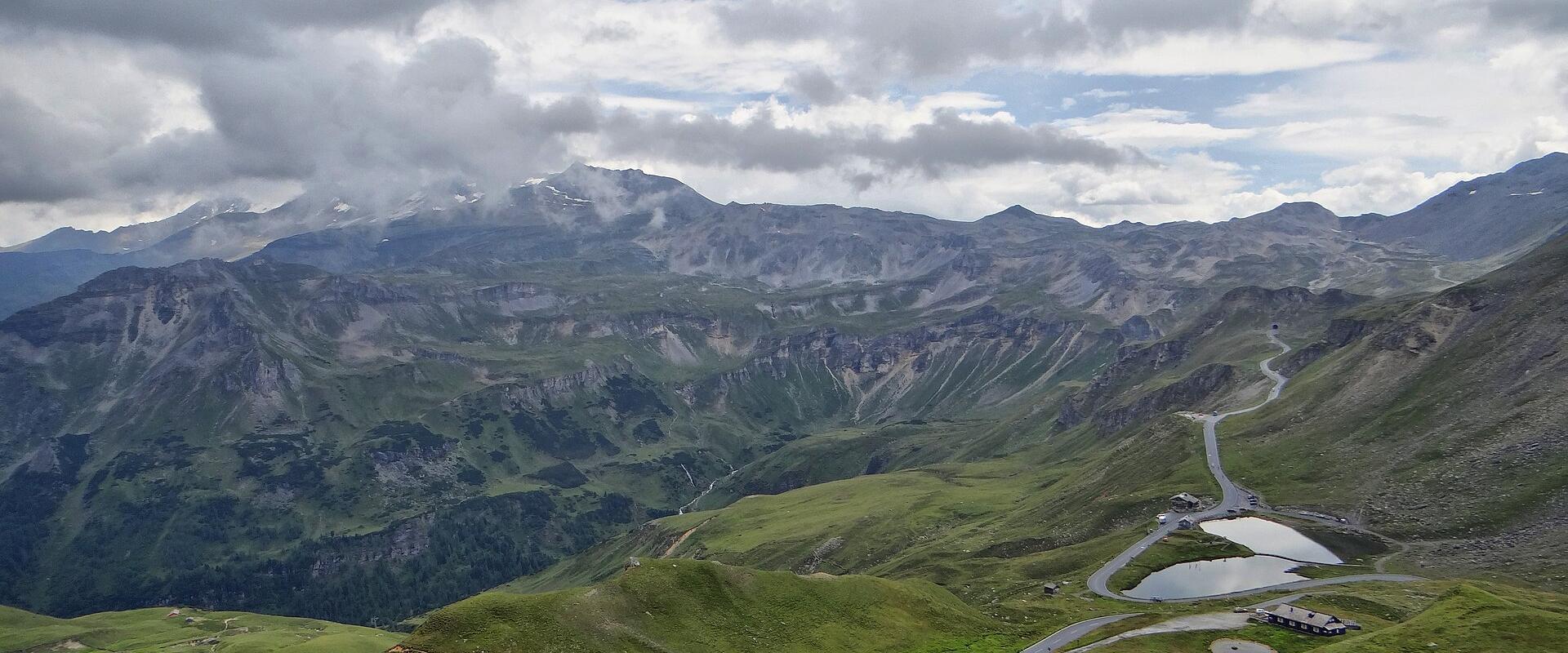
The Grossglockner High Alpine Road, known in German as the Großglockner Hochalpenstraße, was conceived in the late 1920s as a way to create jobs during the economic crisis and to open the Alps to car tourism. Work began in 1930 under the engineer Franz Wallack and took five years, with thousands of labourers working by hand and with simple machinery in difficult conditions, and the road opened in 1935. It crosses the Hohe Tauern mountain range, past the retreating Glacier, between Bruck in the Fuscher valley in Salzburg state and Heiligenblut in Carinthia, with a branch to the Kaiser-Franz-Josefs-Höhe.
The statistics are impressive: 48 kilometres of road, 36 hairpin bends, a high point of 2,504 metres at the Hochtor tunnel, and a gradient of up to 12 per cent. It is the highest paved mountain road in Austria. It is a toll road, and prices depend on the vehicle, so check the current rate. The road is open from about May to October or early November, depending on snow, and storms can close it for hours, so it is wise to look at the road's website or call before you set out. Allow at least three or four hours for the drive, and more if you want to walk.
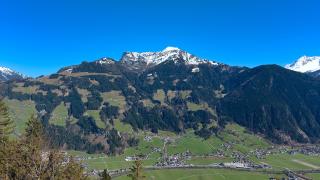
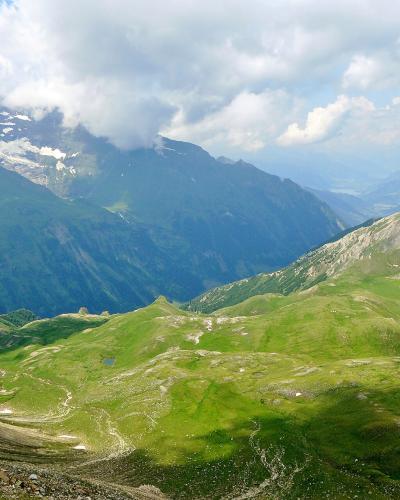
The first main viewpoint is the Fuschertörl, a Pass at about 2,400 metres, where the road emerges above the tree line and the view opens toward the Hohe Tauern. The Fuschertörl Wildlife Detour, a short side route, gives a chance to see ibex and marmots, the Alpine animals that live on the slopes, with information boards. From the pass, the Edelweißspitze, the Edelweiss Spitze or Edelweiss Peak at 2,571 metres, is reached by a short, steep side road, and its lookout gives a panorama over 30 peaks above 3,000 metres, including the Grossglockner.
The highest point of the road is the Hochtor, a tunnel at 2,504 metres at the border between Salzburg and Carinthia. Near it, a small museum and exhibition, listed as the Hochtor Museum, gives information on the road's history, the geology of the region and the local flora and fauna. South of the Hochtor, the road descends toward Heiligenblut, a pilgrimage village with a Gothic church whose slender spire frames the Grossglockner in classic postcards.
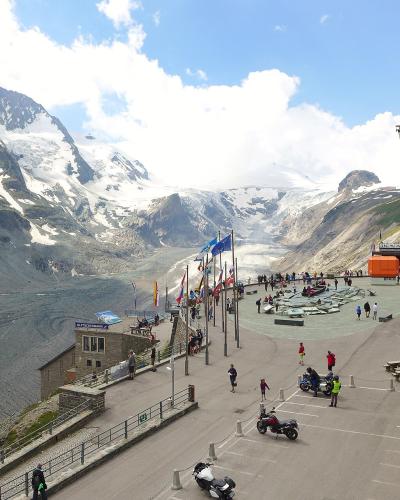
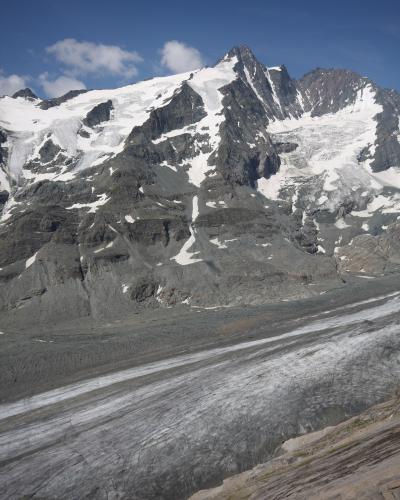
The most famous stop is the Kaiser-Franz-Josefs-Höhe, a viewpoint at 2,369 metres, reached by a side road with a large car park, cafes and a visitor centre. From here you look straight at the Grossglockner and, below, the Pasterze, the largest glacier in the Eastern Alps. The glacier is retreating rapidly because of climate change, and it has lost a great deal of length and thickness since the road opened; a path with information boards leads toward the ice, and an inclined lift runs in season. Marmots often sit near the car park, and they are used to tourists, though feeding them is discouraged.
At the Glocknerhaus, a mountain restaurant and hotel on the way, visitors can rest at one of the highest restaurants in Austria, and a number of other huts and cafes line the route. Nearby is the Hohe Tauern National Park, the largest national park in the Alps, with marked trails of all lengths, including the Gamsgrubenweg, a path that gives views of the glacier. The valley approaches from the north pass waterfalls and meadows with alpine flowers.
Activities beyond driving include hiking, cycling, motorbike touring and photography. Cyclists regard the climb as a classic, a long ascent best done in the early morning, and the road is used for a hill climb event. In June, snow can still lie on the high stretches, and by August the meadows are in flower, while in September and October the light is clear and the crowds thinner, although snow may arrive early.
For food, there are mountain restaurants along the way serving soups, Kaspressknödel, Kaiserschmarrn and strudel. Prices are high, as everywhere in the high Alps, so many visitors bring a picnic.
The best time to go is from late June to early September, when all sections are open and the weather is more stable, though mornings are best for views, before clouds build. Weekends in July and August can be crowded. Dress warmly, because temperatures at the top can be near freezing even in summer.
Getting there is straightforward by car or motorbike. From Salzburg, take the A10 and the road to Zell am See, then the road via Bruck to Fusch, about two hours; from Carinthia, Heiligenblut is reached via Lienz or the Mölltal. Buses run in summer between Zell am See and the Kaiser-Franz-Josefs-Höhe, and organised tours leave from Salzburg and Zell am See.
Best Time to Visit
Visit from June to October for clear weather and open road conditions, with July and August being peak months.
Did you know?
Interesting, verified facts about Grossglockner High Alpine Road
Grossglockner High Alpine Road Has a Second Local Claim
HistoryIt is the highest surfaced mountain road in Austria, reaching an elevation of 2,504 meters at the Hochtor Pass.
Source: Grossglockner High Alpine RoadGrossglockner High Alpine Road Has Another Verifiable Detail
HistoryThe atmosphere is one of awe-inspiring natural beauty and engineering marvel, with 36 hairpin bends winding through alpine landscapes.
Source: Grossglockner High Alpine Road - WikipediaGrossglockner High Alpine Road Has Another Verifiable Detail
RecordThe road offers breathtaking panoramic views of the Hohe Tauern National Park, including Austria's highest peak, the Grossglockner (3,798 meters), and the Pasterze Glacier, the largest glacier in the Eastern Alps.
Source: Grossglockner - WikipediaPlan Your Visit to Grossglockner High Alpine Road
Essential travel tips and information for your trip to Grossglockner High Alpine Road.
Suggested Itineraries
Discovering Grossglockner High Alpine Road
1 dayAustria's highest pass road through Hohe Tauern National Park
View ItineraryTravel Tips
Currency
EUR • Cards widely accepted
Language
German • English in tourist areas
WiFi
Free WiFi in cafes and hotels
Explore Grossglockner High Alpine Road by Interest
Discover attractions and experiences in Grossglockner High Alpine Road organized by your interests and travel preferences.
All attractions in Grossglockner High Alpine Road
Sorted by our recommendation score
Quick Facts
Book your stay
Frequently Asked Questions
More destinations in Salzburg
Explore other amazing places in the Salzburg region