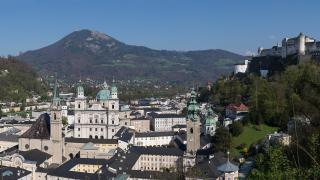
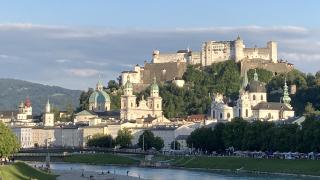
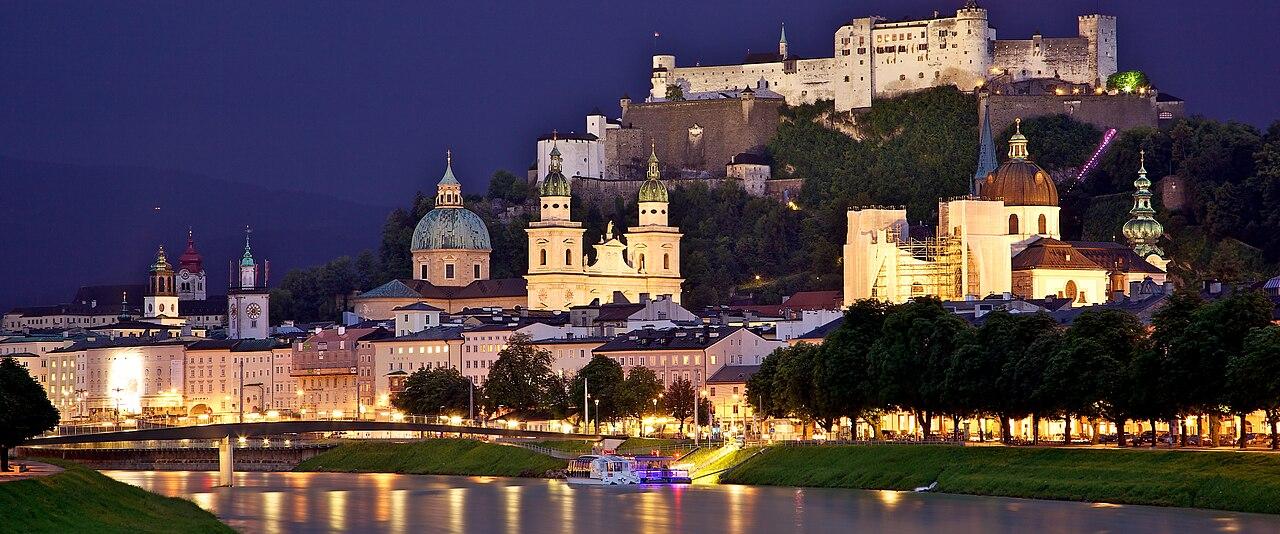
Salzburg sells itself on Mozart and The Sound of Music, and the old town between the river and the fortress looks almost too perfect to be real. Behind the chocolate boxes is a city that gave the world one of its most-sung songs, founded a festival as an act of peace after a world war, ran one of the oldest railways still working, and after 1945 helped tens of thousands of people find their way to a new life.
This is Salzburg's bright side, in roughly the order it happened. Some of its famous stories are true, some are films, and some are claims the city is fond of; we say which is which. Every chapter ends with something you can go and see.
696: The Monastery and the Cellar
The city's story begins with St Peter's Abbey, founded in 696 by the missionary bishop Rupert. It is the oldest monastery in the German-speaking world with an unbroken history since its foundation, and monks still live there. Its little cemetery, at the foot of the cliffs, has catacombs carved into the rock, and the abbey church holds the graves of Mozart's sister Nannerl and the composer Michael Haydn.
Built into the abbey is the St. Peter Stiftskulinarium, which calls itself the oldest restaurant in Central Europe. The claim rests on a poem from 803 by the scholar Alcuin praising the abbey's cellar. That proves the monks served wine, not that a restaurant has run without a break since; but it is a fine place to eat with a long memory.
Where to see it today: St Peter's Abbey and its cemetery, St.-Peter-Bezirk, at the foot of the Mönchsberg, open daily and free.
1077–1515: The Fortress and the Oldest Railway
Hohensalzburg Fortress, begun in 1077, sits on the hill above the city. It is one of the largest medieval castles in Europe, and it was never taken by force: peasants besieged it in vain in 1525, and in 1800 it surrendered to Napoleon's army without a fight.
Up the side of the fortress hill runs the Reisszug, a private cable railway for hauling supplies. It probably existed by about 1460, is first documented around 1496, and was described in detail in 1515. It is very probably the oldest railway in the world still in use: it still carries goods up to the fortress, pulled by electricity since 1910. Visitors ride the separate FestungsBahn funicular, opened in 1892.
 Hohensalzburg Fortress above the Reisszug track and Nonnberg Abbey. Image: Manfred Werner - Tsui, CC BY-SA 3.0, via Wikimedia Commons.
 A wagon of the Reisszug, the fortress's goods railway. Image: Eweht, Public domain, via Wikimedia Commons.
Where to see it today: ride the FestungsBahn from Festungsgasse to the fortress, open daily. From the fortress terraces you can look down on the Reisszug track.
1613–1617: Fountains That Play Tricks
In 1613 the prince-archbishop Markus Sittikus began building Hellbrunn Palace south of the city as a summer pleasure house. Its gardens were filled with water games: hidden jets that soak guests at the dinner table, grottoes with water-powered birdsong, and mechanical figures moved by water. They are the best-preserved late-Renaissance water games in the world, and they still work exactly as they did four centuries ago.
In a former quarry in the park is the Steintheater, a stone stage carved out of the rock around 1616. It is often called the oldest surviving open-air stage north of the Alps, and an opera may have been performed there in 1617, among the first north of the Alps.
 Water-spouting tortoises among the trick fountains at Hellbrunn. Image: Geolina163, CC BY-SA 4.0, via Wikimedia Commons.
 The Steintheater, a stage carved from a quarry at Hellbrunn around 1616. Image: Simonowitz, Public domain, via Wikimedia Commons.
Where to see it today: Hellbrunn Palace, Fürstenweg 37, south of the centre (bus 25). The trick fountains can only be seen on a guided tour, from about April to early November. Expect to get wet.
1621: The Monks' Beer Hall
In 1621 the Augustinian friars of Mülln founded a brewery beside their monastery. The friars are long gone, but the brewery has stayed in monastic hands: since 1835 it has belonged to the Benedictine abbey of Michaelbeuern. The Augustiner Bräu beer hall is a Salzburg institution, where beer is poured from wooden barrels into stone mugs and people bring their own food to eat at long tables.
 The beer hall of the Augustiner Bräu at Mülln. Image: Eweht, CC BY-SA 3.0, via Wikimedia Commons.
Where to see it today: the Augustiner Bräu Kloster Mülln, Lindhofstraße 7, open in the afternoons and evenings, with a big chestnut-shaded garden in summer.
1628: The Cathedral, Twice
After the old cathedral was damaged by fire in 1598, the archbishops tore it down and built a new one in the Italian Baroque style, consecrated on 24 September 1628. Mozart was baptised here in 1756, at a bronze font from 1321 that is still in use.
On 16 October 1944 an American bomb collapsed the cathedral's central dome. It was rebuilt over the next 14 years and completed in 1959, with new bronze doors representing faith, love and hope.
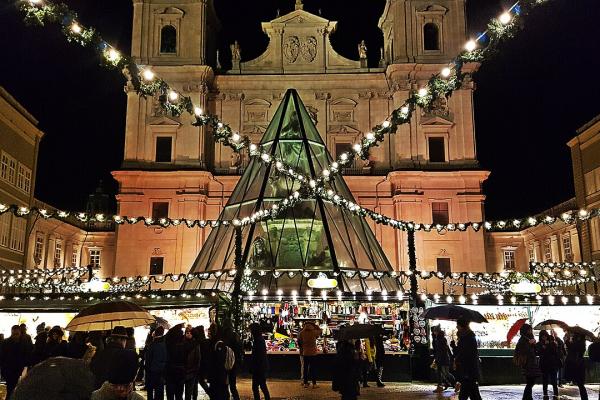
 The façade of Salzburg Cathedral on Domplatz. Image: Uoaei1, CC BY-SA 4.0, via Wikimedia Commons.
Where to see it today: Salzburg Cathedral, Domplatz. Look for the 1321 font where Mozart was baptised and the three bronze doors of the 1950s.
1756: Mozart
Wolfgang Amadeus Mozart was born on 27 January 1756 on the third floor of Getreidegasse 9, and grew up in Salzburg before leaving for Vienna in 1781. The city did not always treat him well in his lifetime, but it has made up for it since. In 1841 the citizens founded the Mozarteum, a music society and school that became one of the leading music universities in the world.
The family's later home on Makartplatz was two-thirds destroyed by the same bombing raid of 16 October 1944. The Mozarteum Foundation bought the ruin and the office block built on the bombed part, and rebuilt the house to its original plans, with funding from a Japanese insurance company. It reopened in 1996.
 Mozart's birthplace, Getreidegasse 9. Image: Andreas Stiasny, CC BY-SA 4.0, via Wikimedia Commons.
 The Mozart Residence on Makartplatz, rebuilt and reopened in 1996. Image: Peter g at szg (talk), CC BY-SA 3.0 at, via Wikimedia Commons.
Where to see it today:
- Mozart's Birthplace, Getreidegasse 9, open daily.
- The Mozart Residence, Makartplatz 8, across the river; a combined ticket covers both.
- Mozart Week, every January around his birthday, since 1956.
1803: Christian Doppler
In 1803 Christian Doppler was born in a house on Makartplatz, a few doors from the Mozart Residence. In 1842 he described what we now call the Doppler effect: why a siren sounds higher as it comes towards you and lower as it goes away. The same principle is used today in weather radar, ultrasound scans, speed cameras and the measurement of the expanding universe.
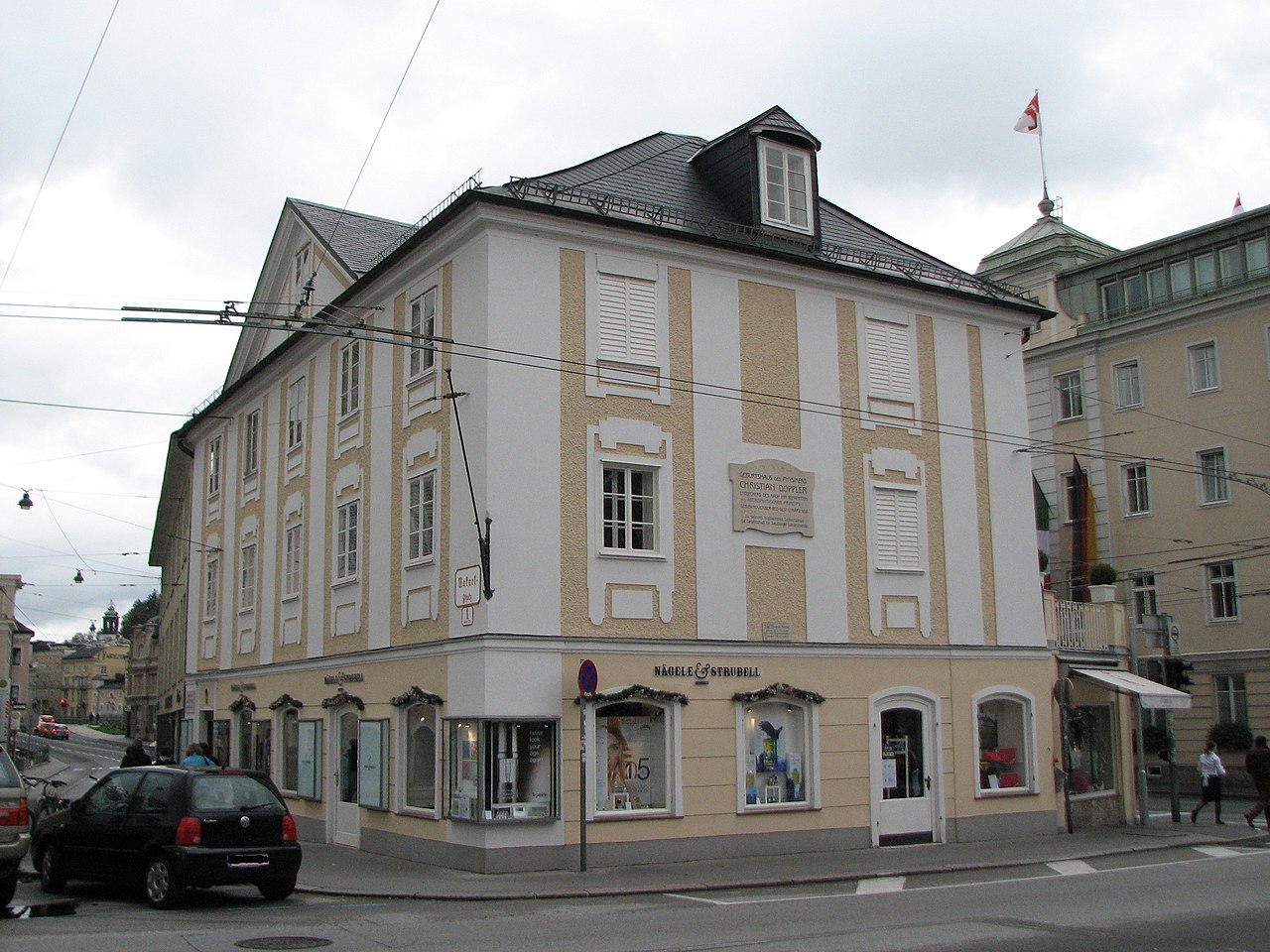 Makartplatz 1, Christian Doppler's birthplace. Image: Peter g at szg (talk), CC BY-SA 3.0 at, via Wikimedia Commons.
Where to see it today: his birth house, Makartplatz 1, marked with a plaque.
1818: Silent Night
In 1816 a young priest born in Salzburg, Joseph Mohr, wrote a six-verse Christmas poem in the village of Mariapfarr. Two years later, as assistant priest at Oberndorf, just north of the city, he asked the schoolteacher and organist Franz Xaver Gruber to set it to music for guitar. On 24 December 1818 they sang "Stille Nacht! Heilige Nacht!" for the first time in the church of St Nicholas in Oberndorf.
The song spread by travelling singers and was carried round the world. It has been translated into more than 300 languages and dialects. In 2011 it was added to Austria's national inventory of intangible cultural heritage.
Mohr was born in poverty, the son of an unmarried mother, in a paupers' house in the old town. He died a poor village priest in 1848.
 An early manuscript of Silent Night in Joseph Mohr's hand. Image: Joseph Mohr; Franz Xaver Gruber, Public domain, via Wikimedia Commons.
 The Silent Night Chapel at Oberndorf, built on the site of the church where the song was first sung. Image: Rufus46, CC BY-SA 4.0, via Wikimedia Commons.
Where to see it today:
- The Silent Night Chapel and museum at Oberndorf, about 20 km north (local train from the main station). The chapel stands on the site of St Nicholas, which was demolished after floods.
- Mohr's birthplace, Kaigasse 9, in the old town.
1920: A Festival for Peace
After the First World War, Austria was poor and divided. In 1920 the theatre director Max Reinhardt, the poet Hugo von Hofmannsthal and the composer Richard Strauss founded the Salzburg Festival as a cultural project to bring people together after the war. On 22 August 1920 it opened with Hofmannsthal's play Jedermann (Everyman), performed outdoors on the cathedral steps.
The Nazis drove Reinhardt and other Jewish artists out after 1938, and the festival was cancelled in 1944. It came back in 1945, and Jedermann has been performed on the cathedral square almost every summer since.
 Domplatz, where Jedermann has been performed on the cathedral steps since 1920. Image: Zairon, CC BY-SA 4.0, via Wikimedia Commons.
Where to see it today: the Domplatz in July and August, when the Jedermann stage stands in front of the cathedral. The festival halls, including the Felsenreitschule, a 1693 riding school carved into the cliff, are on Hofstallgasse.
1938: The Real Von Trapps
The film The Sound of Music made the von Trapp family famous. Some of it is true. Maria Kutschera was a novice at Nonnberg Abbey when she was sent as a tutor to the family of a widowed naval officer, Georg von Trapp, and they married at Nonnberg in 1927. The family sang together and won prizes as a choir.
After Germany annexed Austria in 1938, Georg turned down a commission in the German navy, and the family refused to sing at Hitler's birthday. In September 1938 they left, but not over the mountains: they took a train to Italy, and went on to London and America. The film's escape, and its stern father, are fiction.
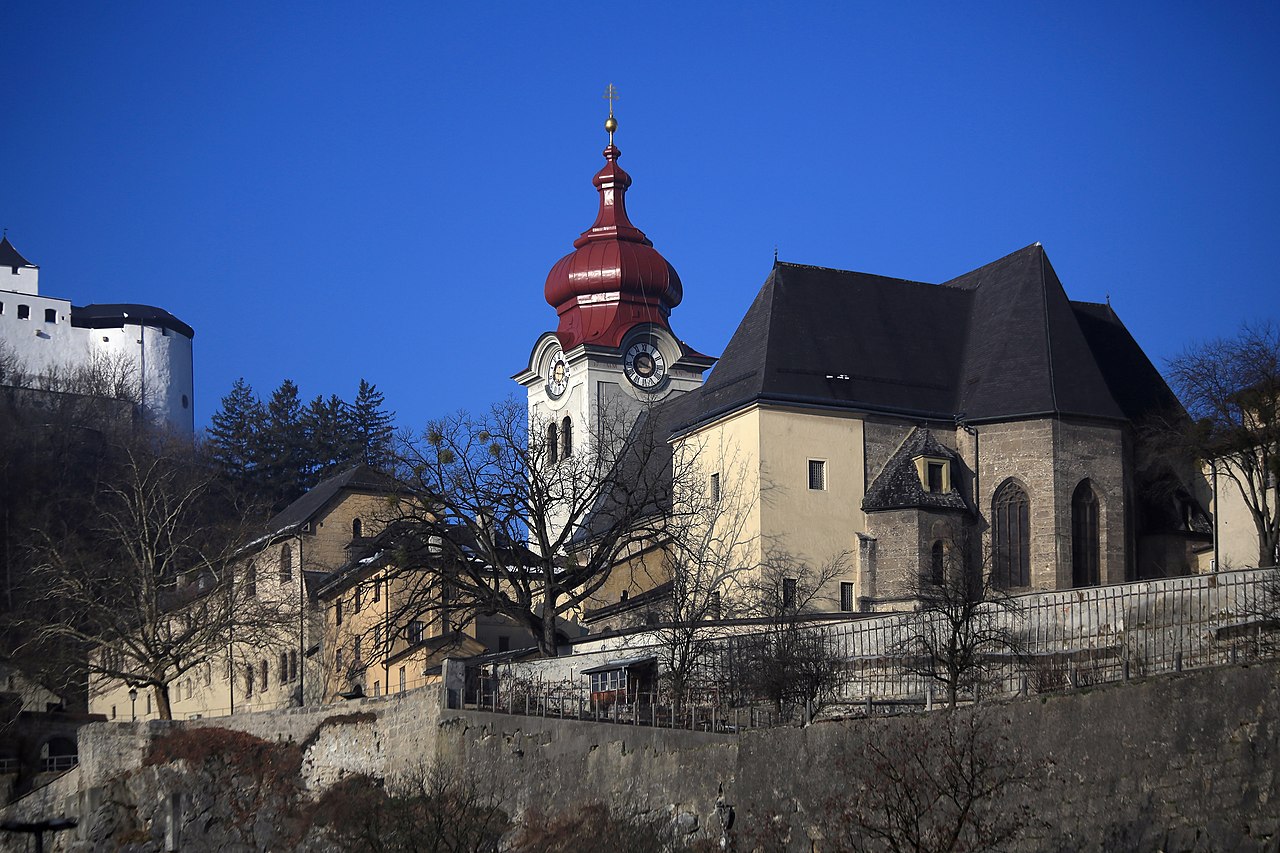 Nonnberg Abbey, where Maria von Trapp was a novice and married in 1927. Image: Manfred Werner - Tsui, CC BY-SA 3.0, via Wikimedia Commons.
 The Mirabell Gardens, with the fortress above. Image: Isiwal, CC BY-SA 4.0, via Wikimedia Commons.
Where to see it today: Nonnberg Abbey, below the fortress, founded about 714 and the oldest continuously existing convent in the German-speaking world. The Mirabell Gardens, where the children sing "Do-Re-Mi" in the film, are free and open daily.
1945–1948: A Way Station to a New Life
After the war, Salzburg was the headquarters of the American zone in Austria. It became one of the main routes for Jewish survivors of the Holocaust leaving Europe. By late 1946 about 13,000 Jews were living in Salzburg's displaced-persons camps, and many more passed through.
One man did more than most to help them. Marko Feingold, a Salzburg Jew who survived Auschwitz and Buchenwald, organised their journey through the city between 1945 and 1948: food, papers, transport and secret crossings over the Alpine passes towards Italy and the ports for Palestine. He is credited with helping about 100,000 people on their way. He led Salzburg's Jewish community for decades and died in 2019, aged 106.
 The Marko-Feingold-Steg footbridge across the Salzach. Image: Leonhard Lenz, CC0, via Wikimedia Commons.
Where to see it today: the Marko-Feingold-Steg, the footbridge across the Salzach between the old town and Makartplatz, renamed after him in 2020. Its railings are covered with lovers' padlocks.
1947: A Marshall Plan of the Mind
In 1947 three Harvard students, led by Clemens Heller, had the idea of bringing young Europeans and Americans together to talk about ideas, two years after their countries had been at war. Max Reinhardt's widow, the actress Helene Thimig, offered them his palace, Schloss Leopoldskron. The first session included the anthropologist Margaret Mead and the economist Wassily Leontief. The press called it a "Marshall Plan of the mind". The Salzburg Global Seminar still meets there today.
 Schloss Leopoldskron, home of the Salzburg Global Seminar since 1947. Image: ManfredK, CC BY-SA 4.0, via Wikimedia Commons.
Where to see it today: Schloss Leopoldskron, on the lake of the same name south-west of the old town. It is now also a hotel. You can see it from the lakeside path.
How to See Bright Salzburg
A self-guided walk, about 4 km. Start at Mozart's Birthplace in the Getreidegasse, walk to St Peter's Abbey and its cemetery, then the Domplatz and the Cathedral. Take the FestungsBahn up to Hohensalzburg and walk down past Nonnberg Abbey. Cross the river on the Marko-Feingold-Steg to Makartplatz for the Mozart Residence and Doppler's birthplace, and finish in the Mirabell Gardens.
Further afield:
- Hellbrunn Palace and its trick fountains (April to early November).
- The Augustiner Bräu at Mülln.
- Schloss Leopoldskron, from the lakeside.
- The Silent Night Chapel at Oberndorf.
Dates to know:
- Late January: Mozart Week.
- July–August: the Salzburg Festival and Jedermann.
- 24 December: Silent Night is sung at the chapel in Oberndorf.