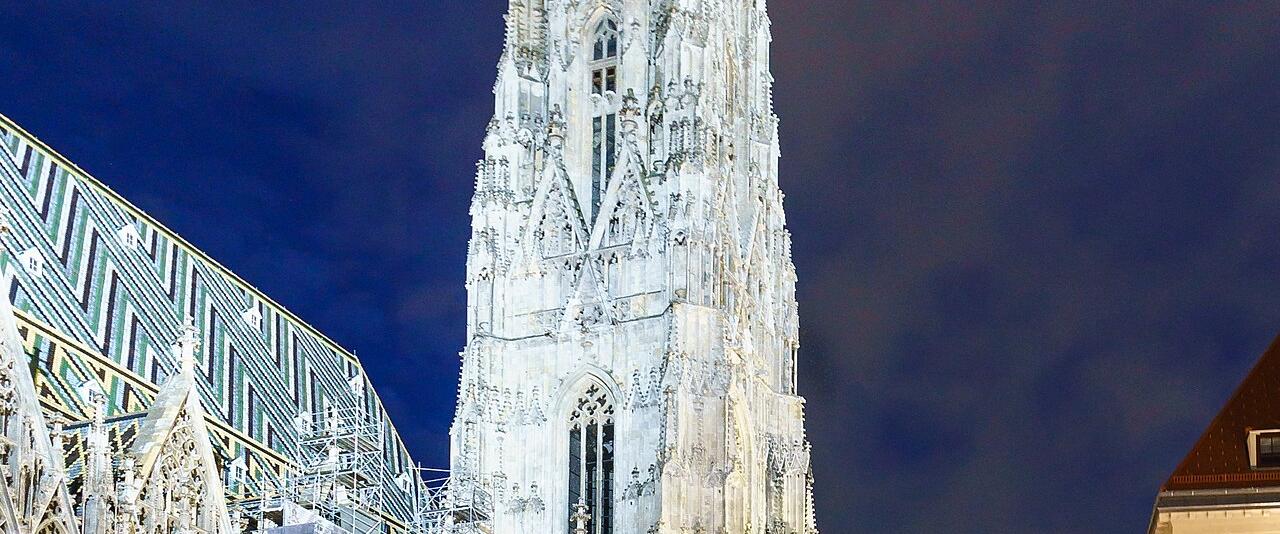
Vienna is the city of waltzes, palaces, coffee houses and Sachertorte. It is also the city that burned its Jewish community alive in 1421, dug plague pits outside its walls, built a round tower to lock away the mentally ill, and buried its emperors in three pieces in three different churches. In 1938 it cheered Hitler on the Heldenplatz and made its Jewish neighbours scrub the pavements on their knees, and a children's ward on the edge of the city killed hundreds of disabled children.
Vienna has spent the last few decades confronting much of this, and the city is now dense with memorials, many of them recent. Most of the stories here left something you can stand in front of: a Latin inscription gloating over a massacre, a cannonball still stuck in a wall, a wall of 64,000 names. This guide follows them in order, from the Middle Ages to the present, and tells you where to find each one. The last section has a walking route and some notes on visiting with care.
1421: The Burning on the Gänseweide
Vienna's medieval Jewish community lived around the Judenplatz, with its synagogue at the centre of the square. On 23 May 1420, on the orders of Duke Albrecht V, all the Jews in Austria were arrested. The poor were put in boats and set adrift down the Danube. Some of those who remained in prison took their own lives in the synagogue. On 12 March 1421, the rest, 92 men and 120 women by one contemporary count, were burned alive on the Gänseweide, a meadow in Erdberg on the edge of the city. The episode is known as the Wiener Gesera. The synagogue was demolished and its stones reused to build the university.
About 70 years later, a new owner of the house at Judenplatz 2 put a relief of the Baptism of Christ on its façade. The Latin inscription beneath it celebrates the 1421 fire as cleansing the city of "the Hebrew dogs". It is still there.
 The relief on the "Zum großen Jordan" house at Judenplatz 2. The inscription below it celebrates the burning of 1421. Image: Wolfgang Sauber, CC BY-SA 3.0, via Wikimedia Commons.
Where to see it today: the relief is on Judenplatz 2. Facing it across the square stands Rachel Whiteread's Holocaust memorial (2000), a concrete cast of a library turned inside out, whose books cannot be read and whose doors cannot be opened. Under the square, the foundations of the burned synagogue were excavated and can be visited from the Museum Judenplatz at number 8 (closed Saturdays). A plaque at Kegelgasse 40, in the 3rd district, marks the area of the Gänseweide.
 Rachel Whiteread's Holocaust memorial on Judenplatz, a "nameless library" with its doors closed. Image: C.Stadler/Bwag, CC BY-SA 4.0, via Wikimedia Commons.
1679: Plague and the Legend of Augustin
In 1679 plague swept through Vienna. Contemporaries claimed 70,000 or more dead; the deaths actually documented number about 8,000 to 12,000, still a large share of the city. The dead were carted to pits outside the walls.
The plague gave Vienna its best-loved legend. Augustin, a bagpiper and drunk, is said to have passed out in the street, been thrown into a plague pit with the corpses, and woken up the next morning unharmed, still playing. A real Marx Augustin may have lived in Vienna at the time, but the story cannot be traced to him, and the song "O du lieber Augustin" was linked to the legend only in the 1870s.
 The Plague Column on the Graben, vowed by Emperor Leopold I during the 1679 epidemic. Image: Jebulon, CC BY-SA 3.0, via Wikimedia Commons.
Where to see it today: the Plague Column (Pestsäule) on the Graben, the city's main shopping street, was vowed by Emperor Leopold I during the epidemic and consecrated in 1693. A figure of Augustin lying in a pit sits at the entrance of the Griechenbeisl restaurant on Fleischmarkt, and there is an Augustin fountain on Augustinplatz in the 7th district.
1683: Cannonballs in the Walls
In 1683 an Ottoman army under the grand vizier Kara Mustafa besieged Vienna for two months, until a relief army under the Polish king Jan III Sobieski broke the siege on 12 September. The city's walls held, but they took a battering. Kara Mustafa was strangled with a silk cord on the Sultan's orders in Belgrade that Christmas. A skull said to be his was displayed in the city museum until 1975 and quietly buried in 2006. Whether it was really his is disputed; Turkish historians say his head was sent to Edirne.
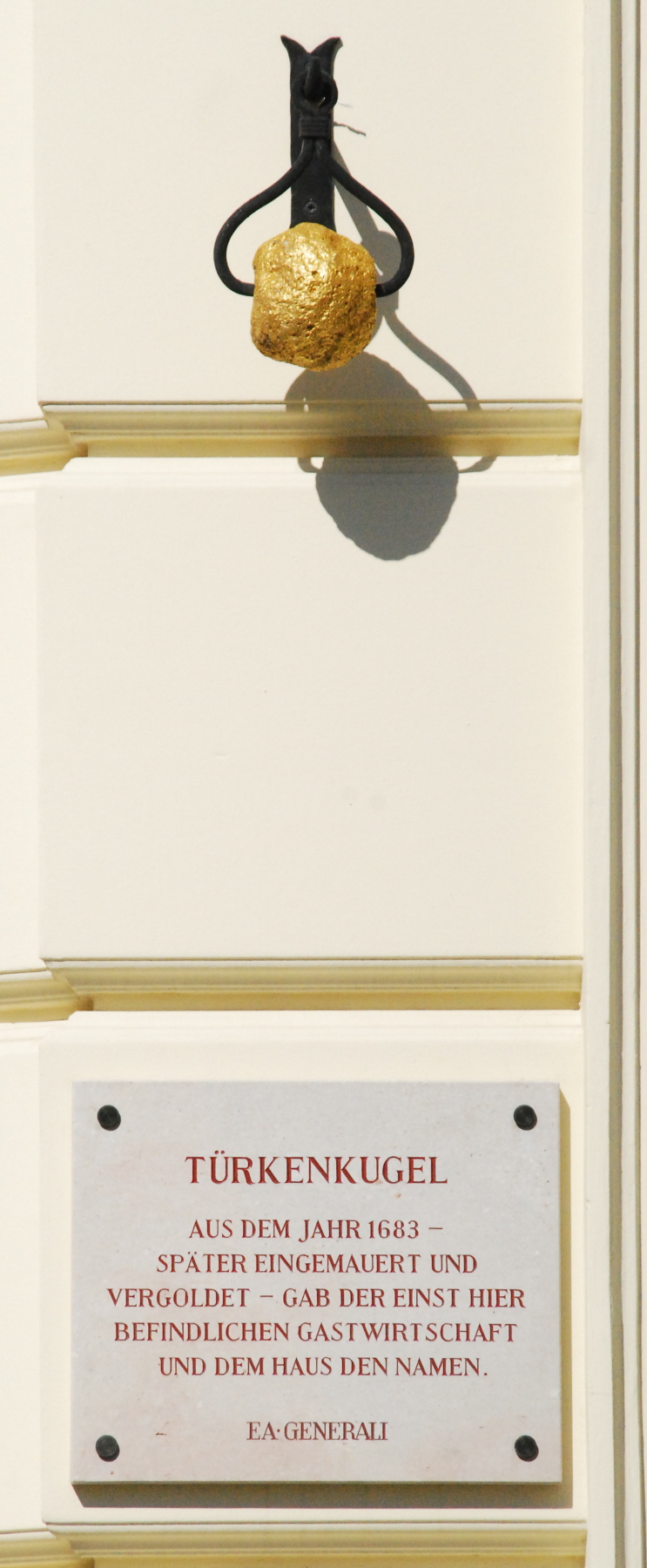 A cannonball from 1683, still fixed to the wall of the house at Am Hof 11. Image: GuentherZ, CC BY 3.0, via Wikimedia Commons.
Where to see it today: Vienna has some 150 to 200 reminders of the sieges. The easiest to find is the gilded cannonball at Am Hof 11, on the corner of Färbergasse, with a plaque beneath it. Others are set into the walls of St. Stephen's Cathedral, marked "1683".
The Gallows and the Last Public Execution
For centuries Vienna's main gallows stood at the Rabenstein, in today's 9th district near Schlickplatz; it was last used in 1786. Another execution site lay on the road south, at the Spinnerin am Kreuz, a Gothic stone column on the Wienerberg. The last public execution in Vienna took place there in May 1868, when Georg Ratkay was hanged. After that, executions moved behind prison walls.
 The Spinnerin am Kreuz on the Wienerberg, painted by Rudolf von Alt in 1841. Public hangings took place beside it until 1868. Image: Rudolf von Alt, Public domain, via Wikimedia Commons.
The darkest chapter came later. Between December 1938 and April 1945, the Nazis beheaded at least 1,210 people with a guillotine in the courtyard of the Landesgericht, the regional criminal court. More than 600 of them were members of the resistance. The last execution in Austria took place there in 1950, and the death penalty was abolished completely in 1968.
Where to see it today: the Spinnerin am Kreuz still stands on Triester Straße in the 10th district. Outside the Landesgericht, at Landesgerichtsstraße 11 in the 8th district, Eva Schlegel's memorial 369 Wochen (2015) remembers those executed there. The former execution room inside, with 619 names on its wall, is opened only for commemorations.
1784: The Narrenturm
In 1784 Emperor Joseph II opened the Narrenturm, the "Fools' Tower", beside the city's new general hospital. It was one of the first purpose-built asylums in Europe: a round, five-storey tower with 139 cells, two patients to a cell, around a central courtyard. The Viennese nicknamed it "Kaiser Josef's Gugelhupf", after the round cake. It was meant as an advance on locking the mentally ill away in prisons and poorhouses, but its narrow cells look like a jail, and it closed as an asylum in 1869.
 The Narrenturm, Vienna's round asylum tower of 1784, now a pathology museum. Image: Herbert Ortner, CC BY 4.0, via Wikimedia Commons.
Where to see it today: the tower, at Spitalgasse 2 in the 9th district, now houses the Federal Pathological-Anatomical Collection, part of the Natural History Museum: 19 rooms of preserved specimens and wax models of disease. It is open Wednesday to Saturday; photography is not allowed. Nearby, the Josephinum on Währinger Straße shows the anatomical wax models Joseph II bought in Florence to train army surgeons.
The Habsburgs in Three Pieces
For about 250 years, Habsburg rulers were buried in three places. Their bodies went to the Imperial Crypt (Kapuzinergruft) under the Capuchin church. Their hearts were placed in silver urns in the Herzgruft, the heart crypt of the Augustinian church in the Hofburg. Their entrails went into copper urns in the ducal crypt under St. Stephen's Cathedral. The heart crypt holds 54 urns, from 1618 to 1878.
 The urns of the Habsburg hearts in the Augustinian church, in an 1872 engraving. Image: , Public domain, via Wikimedia Commons.
At a Habsburg funeral the procession still stops at the door of the Imperial Crypt and a herald knocks. When he announces the dead person by all their titles, the friars inside answer that they do not know them. Only when he calls them "a poor sinner" is the door opened. The ritual was last performed for Otto von Habsburg, the last crown prince, in 2011.
The crypt also holds two of the family's tragedies. Crown Prince Rudolf shot his teenage lover Mary Vetsera and then himself at the hunting lodge of Mayerling in January 1889. His mother, Empress Elisabeth (Sisi), was stabbed to death with a sharpened file by an anarchist in Geneva in 1898. Both lie beside Emperor Franz Joseph.
Where to see it today: the Imperial Crypt on Neuer Markt is open daily. The heart crypt in the Augustinerkirche can be seen on guided tours only. The catacombs of St. Stephen's, with the ducal crypt and the bones of some 11,000 people buried there until 1783, are visited on regular cathedral tours.
1927 and 1934: Vienna Turns on Itself
On 15 July 1927, after a court acquitted right-wing veterans who had shot dead a man and a child at a socialist march, crowds in Vienna set the Palace of Justice on fire. The police were ordered to shoot. 89 people died, 84 of them demonstrators.
 Smoke rising from the burning Palace of Justice on 15 July 1927. Image: Martin Gerlach, Public domain, via Wikimedia Commons.
In February 1934, in a brief civil war, the government used artillery against socialist workers barricaded in the city's huge council housing blocks, above all the Karl-Marx-Hof. Several hundred people died across the fighting.
Where to see it today: the rebuilt Palace of Justice on Schmerlingplatz houses Austria's Supreme Court; its grand central hall can usually be seen on weekdays. The 1-kilometre Karl-Marx-Hof in Heiligenstadt is still lived in; the "Red Vienna" museum in its old laundry tells its story.
1938: The Heldenplatz and the Scrubbing Parties
On 12 March 1938 German troops crossed into Austria. Three days later, on 15 March, Hitler spoke from the terrace of the Neue Burg wing of the Hofburg to a crowd of about 200,000 on the Heldenplatz, announcing the "entry of my homeland into the German Reich".
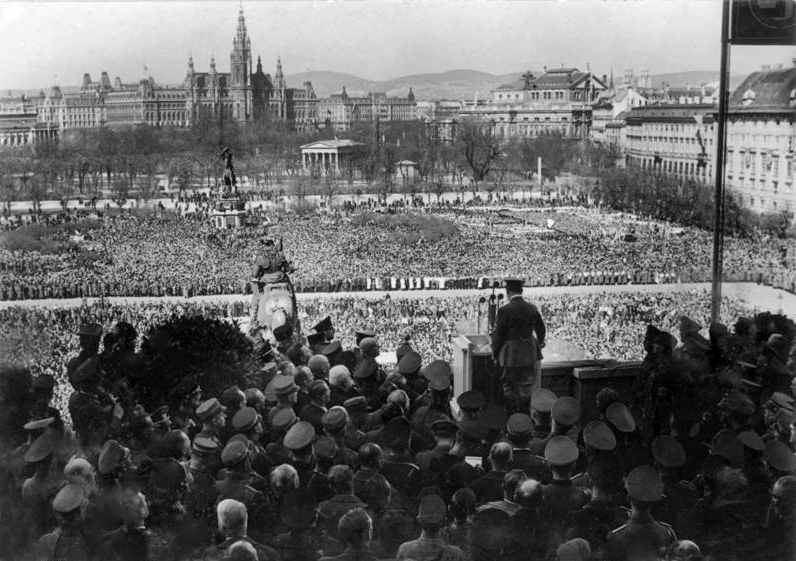 Hitler's speech on the Heldenplatz, 15 March 1938. Image: UnknownUnknown, CC BY-SA 3.0 de, via Wikimedia Commons.
In the days around the Anschluss, Viennese crowds forced Jews to scrub pro-Austrian slogans off the pavements, sometimes with toothbrushes, while onlookers jeered. On the night of 9–10 November 1938, during the nationwide pogrom later called Kristallnacht, 42 synagogues and prayer houses in Vienna were burned and wrecked. The main synagogue, the Stadttempel, survived only because it was hidden inside a block of houses: an 18th-century rule had banned non-Catholic places of worship from facing the street, and burning it would have set the neighbours alight.
 The kneeling Jew scrubbing the street, part of Alfred Hrdlicka's Monument against War and Fascism on Albertinaplatz. Image: Fred Romero from Paris, France, CC BY 2.0, via Wikimedia Commons.
Where to see it today: the terrace of the Neue Burg on the Heldenplatz is still there; the building houses museums. Behind the State Opera, on Albertinaplatz, Alfred Hrdlicka's Monument against War and Fascism (1988) includes a bronze figure of a kneeling Jew scrubbing the street. Barbed wire was added to its back after people kept sitting on it. The Stadttempel, Seitenstettengasse 4, normally opens for guided tours with ID; check whether visits have resumed after its renovation.
1938–1945: The Holocaust in Vienna
About 206,000 people in Austria were persecuted as Jews after 1938. Around two-thirds escaped abroad; more than 65,000 were murdered, most of them deported from Vienna. Between 1939 and 1942, 47 transports left from the Aspangbahnhof station alone. The Gestapo ran Austria from the requisitioned Hotel Metropole on Morzinplatz, by the Danube Canal. Sigmund Freud got out in June 1938; four of his sisters stayed in Vienna and were murdered in 1942.
 Part of the Shoah Wall of Names in the Ostarrichipark, opened in 2021. Image: Christian Michelides, CC BY-SA 4.0, via Wikimedia Commons.
Where to see it today:
- The Shoah Wall of Names in the Ostarrichipark in the 9th district, opened in 2021, carries the names of about 64,500 Austrian Jews murdered in the Holocaust.
- On Morzinplatz, where the Gestapo headquarters stood, a memorial reads "Niemals vergessen" (never forget). The building that replaced the hotel has a memorial room run by the Documentation Centre of Austrian Resistance (by arrangement).
- The Aspangbahnhof memorial in the Leon-Zelman-Park, 3rd district, is a pair of concrete rails running into a dark block.
- Small brass "stones of remembrance" in the pavement outside about 1,000 Vienna addresses name the people deported from them.
- The Sigmund Freud Museum, Berggasse 19, tells the family's story.
Am Spiegelgrund: The Children's Ward
From 1940 to 1945 a children's clinic called Am Spiegelgrund, in the grounds of the Steinhof psychiatric hospital on the city's western edge, took part in the Nazi programme of killing disabled children. About 789 children died there, killed by poison, starvation and exposure. The brains of hundreds of them were kept in jars and used for research for decades afterwards. One of the doctors, Heinrich Gross, continued his career as a respected scientist in post-war Austria and never served a sentence. The children's remains were finally buried in a grave of honour at the Central Cemetery in 2002.
 The memorial at Steinhof: 772 light columns, one for each child remembered at Am Spiegelgrund. Image: Haeferl, CC BY-SA 3.0, via Wikimedia Commons.
Where to see it today: at the former Steinhof hospital, Baumgartner Höhe 1 in the 14th district, a field of 772 light columns stands beside Otto Wagner's Art Nouveau church. The Steinhof memorial exhibition in Pavilion V is open Wednesday to Friday and some Saturdays.
The Third Man's City
After 1945 Vienna was divided among the four Allied powers, like Berlin, and became a black market city of rationing and smuggling. Graham Greene and Carol Reed turned it into The Third Man (1949), in which Orson Welles's racketeer Harry Lime sells diluted penicillin that kills children and escapes his pursuers through the city's sewers.
 The sewer tunnels used in The Third Man, now open on guided tours. Image: Alfred Diem from Wien, Austria, CC BY 2.0, via Wikimedia Commons.
The war also left Vienna six enormous concrete flak towers, built in 1943–44 to carry anti-aircraft guns. They were too massive to demolish economically, so they are still there: one houses the Haus des Meeres aquarium, another stands empty in the Augarten park, cracked by an explosion inside.
Where to see it today: the Third Man sewer tour starts near Karlsplatz and runs from May to October. The Third Man Museum, Pressgasse 25, opens to individual visitors on Saturdays. The flak towers are in the Augarten, Arenbergpark and Esterhazypark (Haus des Meeres).
Terror in the Inner City
On 29 August 1981, gunmen from the Abu Nidal group attacked a bar mitzvah at the Stadttempel, killing two people. And on the evening of 2 November 2020, the last night before a Covid lockdown, an Islamist gunman opened fire in the bar district around the synagogue, killing four people before police shot him dead near the Ruprechtskirche.
Where to see it today: a granite memorial stone to the four victims of 2020 stands on Desider-Friedmann-Platz, a few steps from the Stadttempel.
The Cemetery of the Nameless
On the edge of the city, at Albern in the 11th district, the Danube once washed up the bodies of people who had drowned upstream, many of them never identified. From about 1840 to 1940 they were buried in a small graveyard by the river, the Friedhof der Namenlosen, the Cemetery of the Nameless. Many of the iron crosses carry the word "Namenlos".
 The chapel at the Friedhof der Namenlosen, the Cemetery of the Nameless, by the Danube at Albern. Image: MagdalenaMatyas, CC BY-SA 3.0 at, via Wikimedia Commons.
Where to see it today: the cemetery is always open. It is a long way out: take bus 76A to Alberner Hafen and walk to the end of the road by the grain silos.
How to See Dark Vienna Respectfully
A self-guided walk, about 4 km. Start on the Heldenplatz under the Neue Burg terrace, then cross to the Augustinerkirche and walk to Albertinaplatz and Hrdlicka's monument. Continue to the Imperial Crypt on Neuer Markt and up the Graben to the Plague Column. Look for the cannonballs on St. Stephen's, then walk to Am Hof 11 and on to Judenplatz, with the 1421 inscription and Whiteread's memorial. Finish on Morzinplatz and Desider-Friedmann-Platz by the Stadttempel.
Further afield:
- The Narrenturm and the Josephinum in the 9th district.
- The Shoah Wall of Names in the Ostarrichipark, near the Narrenturm.
- Steinhof and the Spiegelgrund memorial, in the 14th district.
- The Friedhof der Namenlosen at Albern.
- The Third Man sewer tour, May to October.
Dates the city remembers:
- 12 March: the 1938 Anschluss.
- 5 May: Austria's day against violence and racism, the anniversary of the liberation of Mauthausen.
- 2 November: the 2020 attack.
- 9 November: the 1938 pogrom.
A few ground rules. Don't sit or climb on the Hrdlicka monument or Whiteread's memorial; that is why the barbed wire is there. Photography is banned in the Narrenturm and is often restricted in the crypts. At Steinhof and the Wall of Names, remember that families still come to find their relatives' names.

.JPG)


.jpg)
.jpg)


