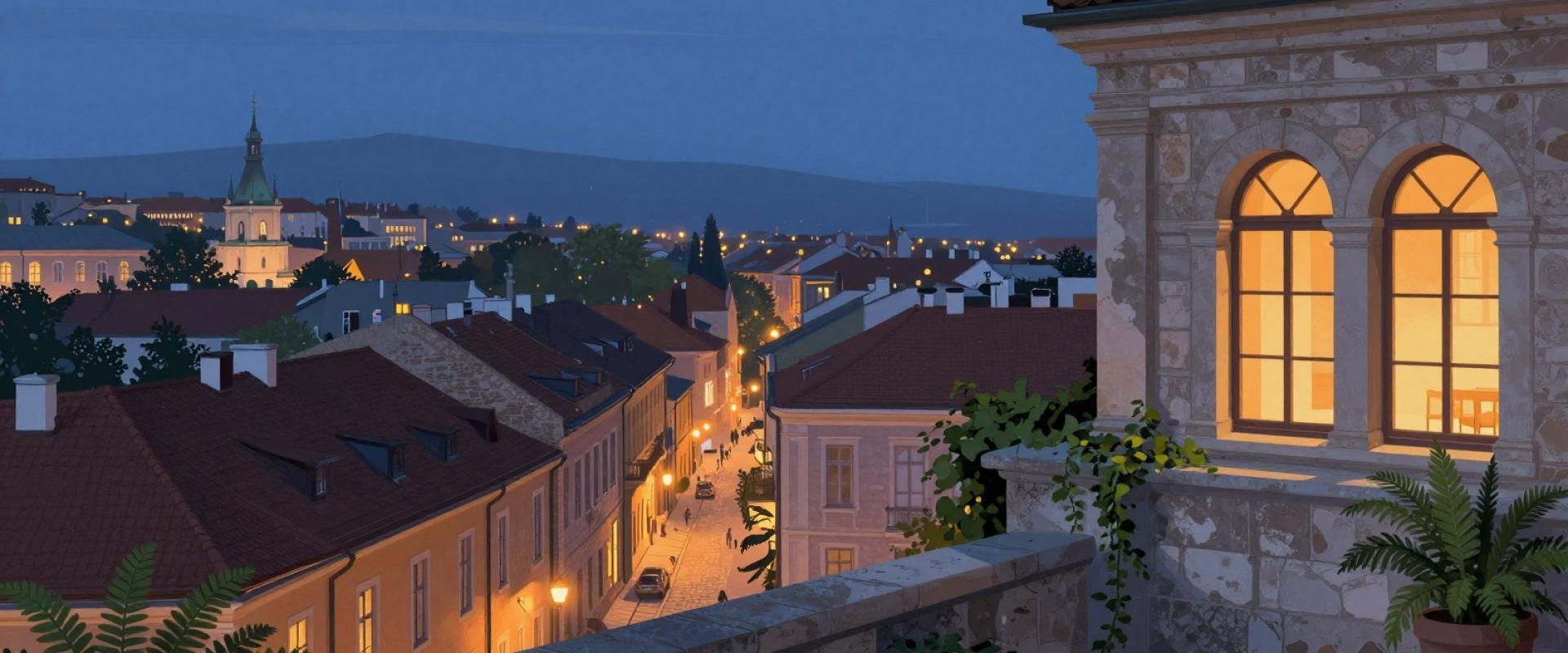
Ascending the Schlossberg at Twilight
The sun surrenders to the horizon, stretching long, dramatic shadows across Graz’s UNESCO-listed old town. As twilight descends, the frantic energy of the pedestrian zone dissolves into a hushed reverence. Decades ago, I stood on the Schlossberg’s peak, watching the Uhrturm’s clock face glow like a golden eye against a deepening violet sky. This vantage point offers more than mere sightseeing; it provides a tangible connection to the Habsburg legacy that once dominated these hills.
From the terrace of Hu:goes 14, the Mur River winds like a silver ribbon through the urban sprawl. The air grows cooler, carrying the faint, earthy scent of roasting chestnuts from the streets below. While the ground level buzzes with tourist chatter, the rooftop remains a sanctuary of quiet contemplation. Here, a glass of local St. Laurent wine tastes sharper, more complex, reflecting the terroir of the region. The contrast between historic architecture and the modern skyline creates a silent dialogue between eras. This space is not simply a bar; it is a stage where the city performs its nightly ritual. Ascend the Schlossberg not just to see the view, but to feel the weight of history settling gently upon your shoulders. It is a moment of pure, unadultered Austrian elegance.
Sip and Savor: Styrian Vines Above the Clouds
As dusk settles over Graz, the Schlossberg stands stark against the darkening sky, framing a scene where imperial history blends seamlessly with modern life. Hu:goes 14 offers a refuge perched high above the city’s pulse, delivering views that feel worlds away from the streets below. A sommelier guides you through local treasures, starting with a crisp, mineral-rich Grüner Veltliner. You might also try Schilcher, a distinctive rosé from Weststeiermark, known for its sharp, refreshing character. These bottles tell the story of Styria’s soil, turning each sip into a taste of place.
The food matches the wine’s intensity. Artisanal plates bring together pungent Schabziger cheese and smoked trout from the Mur River, offering textures that contrast beautifully with the wine’s acidity. Service remains attentive but discreet, allowing conversation to flow as easily as the pour. A glass of premium Schilcher costs between €8 and €12, a reasonable price for such quality and context. This isn’t just about drinking; it’s about capping off a day of architectural discovery with quiet luxury. The blend of local produce and refined presentation creates a space to linger. Here, the weight of history lifts, replaced by the simple pleasure of a well-crafted evening.
Graz’s Old Town holds its breath after the final tram rattles away, leaving cobblestones that seem to hum with the echoes of Habsburg power. Walking up Schloßbergstraße feels less like tourism and more like slipping into a preserved moment. The 15th-century Uhrturm watches over the street, its clockwork mechanisms ticking with a rhythmic precision that feels oddly personal in the quiet. Summer sunsets here are aggressive, painting Baroque facades in gold before the sky darkens enough for stars to assert themselves. This delay is intentional. It lets you absorb the scale of the architecture before the crowds dissolve into the night.
I usually begin at the Kunsthaus, that bulbous, alien structure that looks like it crash-landed from a sci-fi movie. Its stark, futuristic lines create a jarring but necessary contrast to the ornate historic center. From there, the real journey starts. You can take the funicular up the Schlossberg hill or choose the 260 stone steps. The physical exertion is a reminder of the city’s defensive roots. Every step up is a connection to the past, a literal elevation above the streets below. The air grows cooler as you climb, shedding the day’s heat.
At the summit, the city transforms. Graz’s lights scatter across the valley like diamonds dropped on black velvet. The view stretches toward the Styrian Alps, a panorama that has inspired composers for centuries. It is a quiet moment, detached from the imperial noise below. The weight of history feels lighter here, suspended in the cool night air. Finish the evening at hu:goes14, a rooftop bar perched on the edge of the museum. The transition from ancient stone to modern leisure is seamless. You sip a drink, watching the city glow below, carrying the weight of centuries lightly. It is not just a view; it is a perspective shift. The climb was worth it. The drink tastes better. The history feels lived-in.
A Legacy of Light and Stone
Graz’s essence reveals itself not in its masonry, but in the way light plays across it. Standing on these historic rooftops, the Mediterranean breeze carries echoes of Habsburg grandeur, mixing with the modern clink of glassware below. At Hu:goes14, an Aperol Spritz costs roughly €8, yet the view of the Schlossberg’s silhouette against the twilight sky feels priceless. This elevation offers a unique vantage point where imperial history meets contemporary leisure.
The sun dips below the alpine horizon, casting long shadows over the Mur River. The evening air wraps around you, warm and heavy. As city lights flicker on, the dialogue between eras becomes clear. Austria’s legacy isn’t frozen in time; it lives in these shared moments. The night sky above Graz remains a silent witness, inviting you to carry this memory forward.