Why Graz works well in bad weather
Graz is Austria's second-largest city and the capital of Styria, and its old town is part of a UNESCO World Heritage site that was extended in 2010 to include Schloss Eggenberg. On a dry day most visitors spend their time outdoors, climbing the Schlossberg or wandering the lanes around the Hauptplatz. When it rains, the city still has plenty to offer, because a large share of its sights sit inside a single museum organisation, the Universalmuseum Joanneum.
The Joanneum was founded in 1811 by Archduke Johann and is the oldest museum in Austria. Today it runs more than a dozen venues in Graz and around Styria, which makes it possible to build a whole wet-weather day on one ticket.
One ticket for the whole day
The Joanneum sells 24-hour and 48-hour tickets that cover all of its exhibitions except the Herberstein animal park outside the city. In 2026 the adult 24-hour ticket costs €20, the 48-hour ticket €26, and a family 24-hour ticket (two adults and up to two children under 14) costs €40. Children under six go free. Guided tours are paid separately.
Because the clock starts when you first use the ticket, a late-afternoon start lets you finish the next morning. Opening hours vary by venue and some smaller museums close on certain weekdays, so check each museum's page on museum-joanneum.at before you plan the order.
Kunsthaus Graz
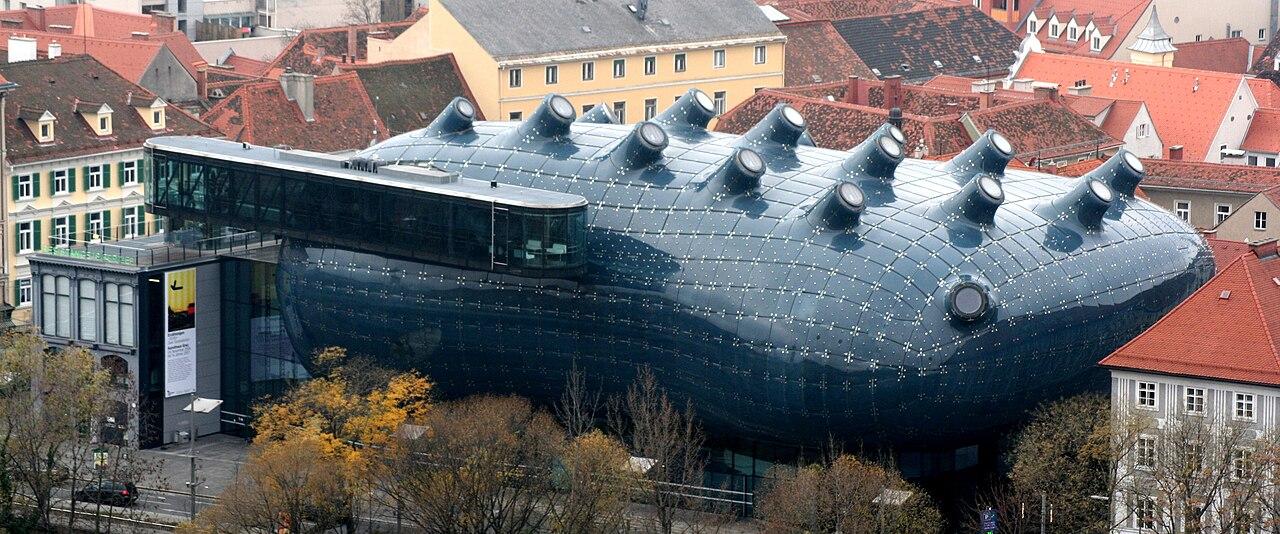
The Kunsthaus is the building most people photograph: a blue, bulging structure on the west bank of the Mur, designed by Peter Cook and Colin Fournier and opened in 2003, when Graz was European Capital of Culture. Locals call it the "friendly alien."
It does not have a permanent collection. Instead it runs changing exhibitions of contemporary art, architecture, design, new media, film and photography from the 1960s onward. What you see depends entirely on the current programme, so look at the exhibition listing before going. The building itself is worth the visit on a grey day, and its location next to the Murinsel footbridge makes it an easy first stop.
The Styrian Armoury
The Landeszeughaus, on Herrengasse in the old town, is the most unusual museum in Graz. It is a 17th-century weapons depot of the Duchy of Styria that still holds around 32,000 objects: suits of armour, helmets, pikes, swords and early firearms, arranged floor after floor much as they were stored when Graz was a frontier city facing Ottoman attacks.
The rooms are packed and fairly dim, which suits a rainy afternoon. Allow at least an hour. Because it is popular with groups, early in the day or late afternoon tends to be calmer.
The Joanneum Quarter and the History Museum
A short walk from the Armoury, the Joanneum Quarter combines the original Joanneum building, a modern extension on Neutorgasse and the Styrian Provincial Library around a sunken courtyard. Several museums share the complex:
- Neue Galerie Graz – modern and contemporary art, with a large collection of works on paper.
- Natural History Museum – botany, zoology, geology, palaeontology and minerals.
- CoSA (Center of Science Activities) – a hands-on science centre aimed at older children and teenagers, opened in 2019.
The History Museum, in the Herberstein Palace on Sackstraße, covers Styrian cultural history and includes Baroque state rooms. The Folk Life Museum, in a former Capuchin monastery below the Schlossberg, holds Styria's largest folk culture collection. Both are close enough to walk between in a light rain.
Schloss Eggenberg
Eggenberg Palace sits on the western edge of the city and is easy to reach by tram. It is a Baroque palace with 24 state rooms and a large landscaped park, and it is the part of the World Heritage site that lies outside the old town.
Inside the palace complex you will find three more Joanneum collections: the Alte Galerie (European paintings from the Middle Ages to the 18th century), the Coin Cabinet, and the Archaeology Museum, which includes prehistoric, Roman and Egyptian finds. The state rooms are usually shown on guided tours with set times and a season, so check the schedule if they are your main reason for going. The museums themselves make a good half-day in poor weather, and if the rain stops, the park is right outside.
A sample rainy-day route
- Morning: Start at the Kunsthaus, cross the Murinsel footbridge, and walk to the Armoury on Herrengasse.
- Lunch: The old town around Hauptplatz and Herrengasse has many cafés and lunch options within a few minutes of the Armoury.
- Afternoon: Spend two or three hours in the Joanneum Quarter, choosing between the Neue Galerie, the Natural History Museum and CoSA depending on your interests.
- Next morning: Use the remaining hours of a 24-hour ticket at Schloss Eggenberg.
If you are travelling with children, CoSA and the Natural History Museum are the strongest choices. For art, combine the Kunsthaus, the Neue Galerie and the Alte Galerie at Eggenberg.