
Austria's Krampus runs (Krampusläufe) take place from early November to early December 2026, with the busiest nights on 5 December, the eve of St Nicholas Day. In Salzburg the Krampus run at the Christkindlmarkt is on Saturday 5 December 2026, around 19:00 on Domplatz; in Innsbruck the runs go through the old town on 3 and 4 December; and in Graz the big Krampus parade is unusually early this year, on Sunday 8 November 2026. Most runs are free to watch. Graz is the exception, with tickets sold in advance.
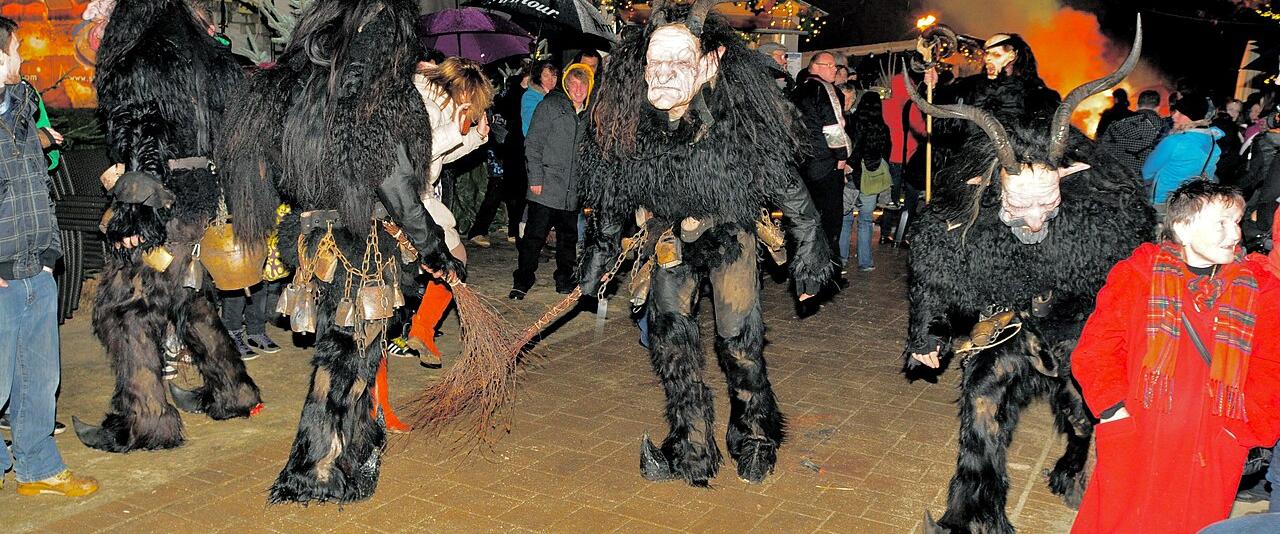
A Krampus run is loud, smoky and deliberately frightening: groups of men in carved wooden masks, long fur suits and heavy cowbells charge down a street lined with spectators, often after St Nicholas has handed out gifts to the children. This guide explains what you are watching, where and when to see it in 2026, and how to watch safely.
 Krampus figures in smoke at a Krampus run in Wiesing, Tyrol, in December 2024. Image: LensaCibi, CC BY-SA 4.0, via Wikimedia Commons.
What is a Krampus?
In the Alpine tradition the Krampus is a devil-like creature who accompanies St Nicholas (Nikolaus, or Nikolo in Austria) on his feast on 6 December. Salzburg's tourist board describes him carrying chains and a switch and looking for children who have misbehaved, while St Nicholas rewards the well-behaved ones.
According to Tirol's tourist board, the Krampus took on his role as the saint's companion in the Nicholas plays of the Counter-Reformation, where he had an educational job: to frighten children into good behaviour. Krampuses appear in Tyrol's Nicholas plays of the 18th century. The popular explanation that the figures drive out the evil spirits of winter dates only from the Romantic movement of the 19th century. The names change from valley to valley: Teufel, Tuifl, Krampal, Kleibeife.
 A hand-carved wooden Krampus mask from Tyrol, with horns and a long tongue. Image: Leontari1; Anton Baumgartner (Bildhauer), CC BY-SA 3.0, via Wikimedia Commons.
Krampus or Perchten: what's the difference?
People often use the two words for the same thing, and many runs include both, but they are different traditions.
- Krampus belongs to St Nicholas and appears in late November and early December, up to 6 December.
- Perchten are folk figures found only in the Alpine regions of Austria and Bavaria. They come in two kinds: the "beautiful" Schönperchten and the "ugly" Schiachperchten, whose masks are the frightening ones. They traditionally appear during the Rauhnächte, the nights between Christmas and 6 January. Tirol's tourist board traces the Perchten in Tyrol back to the 17th century.
That is why Salzburg holds its Krampus run on 5 December and its Perchten run on 21 December, the first of the Rauhnächte by the Christmas market's count.
When are the Krampus runs?
Traditionally the Krampus season starts after 11 November (St Martin's Day) and peaks on the evening of 5 December, Krampusnacht. On 6 December, St Nicholas Day, the saint visits children with gifts. Because there are more groups than evenings, runs now spread across late November and the first week of December, and the bigger towns have several. Most start after dark, between 17:00 and 19:30.
Salzburg
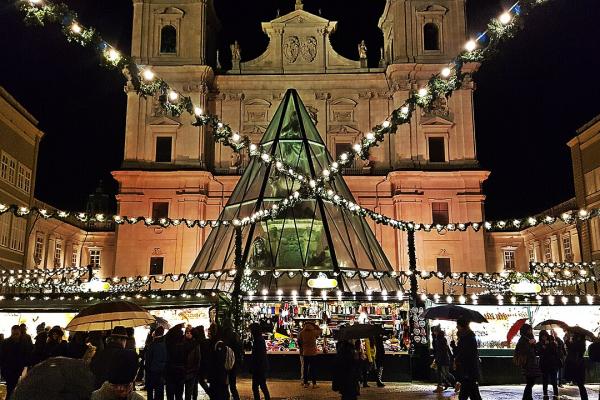
Salzburg's Krampus calendar is full. The Christkindlmarkt on Domplatz and Residenzplatz runs from 19 November 2026 to 1 January 2027, and its own programme includes:
- Krampus run at the Christkindlmarkt: Saturday 5 December 2026, expected around 19:00 on Domplatz.
- Nikolo and the children's Krampus: Sunday 6 December 2026 at 15:30, a gentler version for young children.
- Perchten run: Monday 21 December 2026, expected around 19:00 on Domplatz.
 A Krampus with horns and a fur suit at a Krampus event in Salzburg. Image: MatthiasKabel, CC BY 2.5, via Wikimedia Commons.
Other runs in and around the city listed by Salzburg's tourist board:
- Linzer Gasse: the Barmstoana Perchten and Krampusse run along Linzer Gasse, on the right bank of the old town, on Saturday 5 December 2026 from 17:00.
- Old town: a separate Krampus run in the old town, also on 5 December 2026.
- Viehhausen (Wals-Siezenheim): the Viehhauser Krampuslauf, organised by the Teufelsgraben Pass, on Friday 27 November 2026 from 18:30, with St Nicholas handing out small gifts to children.
- Siezenheim: the Siezenheimer Krampuslauf on the village square on Monday 7 December 2026. It is held every year on 7 December, with groups from Großgmain and Wals; the listing gives 17:30, and the run itself usually starts around 19:00.
- Maxglan: the Maxglaner Krampuslauf on Tuesday 8 December 2026.
Innsbruck and Tyrol
In Innsbruck, Krampus and Perchten groups parade through the old town and the Christmas markets on 3 and 4 December 2026. Innsbruck Tourism, which organises the evenings, also runs a calmer St Nicholas procession, in which the saint, with angels and a well-behaved Krampus, hands out small presents to children. Times had not been published when this guide was written.
Elsewhere in Tyrol, the tourist board lists these runs for 2026:
- Igls: Sunday 29 November 2026. After St Nicholas has handed out gifts, the Krampuses, led by the Obertuifl, run noisily through the village above Innsbruck.
- Seefeld: Krampustreiben on Friday 4 December 2026.
- Kundl: Perchten run and arrival of St Nicholas on Saturday 5 December 2026.
- Rattenberg: Perchten run and witches' dance on Sunday 6 December 2026.
- Lienz, East Tyrol: Krampus and St Nicholas days from 3 to 6 December 2026, with processions through the town centre and smaller villages around it. The figures wear carved wooden masks called Larven, shaggy furs and heavy bells, and barriers and stewards keep spectators close but safe.
Customs differ from valley to valley. In Matrei in East Tyrol the Krampuses (Kleibeife) take part in Tischziehen, a scuffle over a table that, as the tourist board notes, does not always end without injuries. Pyrotechnics are frowned upon in Matrei, while in North Tyrol smoke and fire are common.
 St Nicholas with angels and Krampus figures at an Austrian St Nicholas visit. Image: Naturpuur, CC BY-SA 4.0, via Wikimedia Commons.
Graz and Styria
The Grazer Krampuslauf, the city's big Krampus parade with numerous groups, moves forward by about a month in 2026. It takes place on Sunday 8 November 2026 on Karmeliterplatz and Freiheitsplatz, ahead of the usual start of the season after 11 November. Graz Tourism says the date was moved because of construction work and a clash with other major events.
Practical info: Karmeliterplatz and Freiheitsplatz, Graz old town. Entry from 13:30, children's programme from 14:00, parade from 18:00. Tickets are sold in advance through oeticket.
Graz Tourism also lists runs in towns around Graz:
- Kalsdorf bei Graz: "Lauf der Finsternis", 7 November 2026, starting at 16:59
- Frohnleiten: Krampustreiben, 7 November 2026, 18:00
- Premstätten: Perchten run, 14 November 2026, 17:30
- Köflach: Krampus run, 21 November 2026, 18:00
- Semriach: Perchten run, 21 November 2026, 18:00
- St. Radegund: Krampus and Perchten run, 12 December 2026, 17:00
Gastein valley
In the Gastein valley south of Salzburg, the Krampus groups, called Passen, move through the villages in early December, and the season's sound is the bells and rattling chains in the streets. The valley's tourism office lists three Krampuskränzchen for 2026, informal evening gatherings in Dorfgastein before the main Krampus days: on 20 November at 19:00 at the football ground, on 27 November at 17:00 at the Schmankerlhütte (organised by the Alpenverein, free entry), and on 28 November at 17:00 at the fire station. The main Krampus days are 5 and 6 December every year, when 80 to 100 Passen go from house to house across the valley from about 16:30; check the event calendar on the Gastein tourism website for street times.
Is a Krampus run safe for visitors?
Mostly, yes, if you keep your distance and follow the rules. Krampuses run fast, swing switches and chains and sometimes go for the crowd, and some runs use smoke and fire. Graz Tourism's advice for visitors:
- Follow the instructions of the stewards.
- Keep a safe distance from the masked performers.
- The evening runs are dark, loud and intense, and can frighten young or noise-sensitive children. A spot further back from the route is more comfortable.
- Bring hearing protection if you are sensitive to noise.
- For small children, choose a daytime children's programme, such as the one at the Graz parade from 14:00 or the Nikolo and children's Krampus at the Salzburg Christkindlmarkt on 6 December.
 Krampuses with bells and switches passing close to spectators at a Krampus run in Pörtschach, Carinthia. Image: Johann Jaritz, CC BY-SA 3.0 at, via Wikimedia Commons.
A few more points of etiquette:
- Stay behind the barriers where there are barriers, and don't follow a group into side streets.
- Don't grab at masks, horns or bells, and don't try to provoke the runners. Many masks are hand-carved and belong to the person wearing them.
- Ask before taking close-up photos of a Krampus outside the run itself. Many will pose; some stay in character.
- Wear old, warm clothes and sturdy shoes. You will be standing in the cold, and soot or smoke can mark your clothes.
St Nicholas on 5 and 6 December
Before the Krampuses, there is St Nicholas. In Austria he appears as a bishop, with mitre and crozier, often accompanied by angels. On 5 and 6 December he visits families, schools and Christmas markets, asks children whether they have been good and gives them small gifts: often fruit, nuts and sweets. If you are in Salzburg, the Christkindlmarkt welcomes the Nikolo on 6 December 2026 at 15:30.
 "Nikolaus und Krampus", a painting by Rudolf Hausleithner. Image: Rudolf Hausleithner, Public domain, via Wikimedia Commons.
Around 1900 Austrians sent each other Krampus postcards ("Gruß vom Krampus", "Greetings from the Krampus"), some playful and some menacing.
 A Krampus postcard from around 1900, "Gruß vom Krampus". Image: Unknown authorUnknown author, Public domain, via Wikimedia Commons.
Tips for visiting
- Best dates: 3 to 6 December, when Innsbruck, Salzburg, Lienz and the Tyrolean villages all have runs. For Graz, come in early November this year.
- Combine it with a market: Salzburg's and Innsbruck's runs pass through or start at the Christmas markets, so you can see both in one evening. See our guide to the Salzburg Christmas markets.
- Arrive early: For the big runs, find a spot along the route at least half an hour before the start. Front-row places go first.
- Getting there: Salzburg, Innsbruck and Graz are on the main railway lines, and the old-town runs are on foot from the main stations. For village runs, check the last train or bus home before you go.
- Check the date: The dates above come from the tourist boards of Salzburg, Tirol, Graz and Gastein and from the Salzburg Christkindlmarkt. Times marked "expected" can change, and runs can be cancelled in bad weather. Check the organiser's listing on the day.