Old town, new landmarks
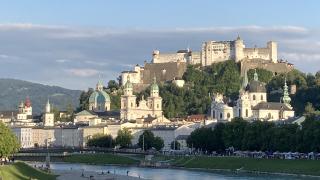
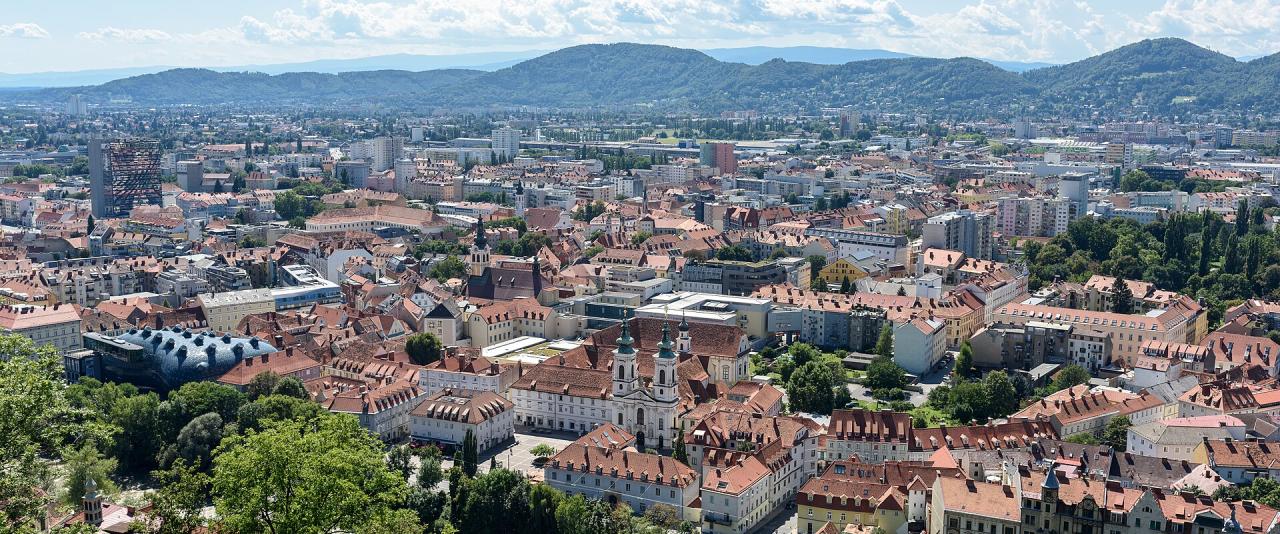
Graz is best known for its historic centre, a UNESCO World Heritage Site since 1999, with Eggenberg Palace added to the listing in 2010. Yet the city also has a strong tradition of contemporary architecture, and in 2011 it joined the UNESCO Creative Cities Network as a City of Design. The turning point for visitors came in 2003, when Graz was European Capital of Culture. Two projects built for that year, the Kunsthaus and the Murinsel, now stand on and beside the Mur river within sight of the Clock Tower on the Schlossberg.
The Kunsthaus Graz
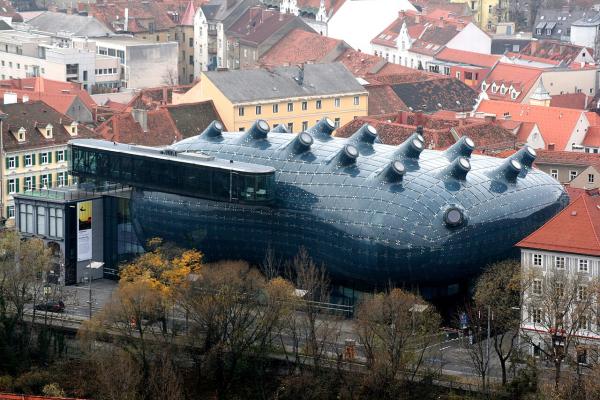
The Kunsthaus Graz is a museum for contemporary art on the west bank of the Mur, opposite the old town. It was designed by the British architects Peter Cook and Colin Fournier and opened in 2003. Its bulging, blue-black skin and the tube-like "nozzles" on the roof, which bring daylight into the top floor, earned it the nickname "Friendly Alien".
Things to notice:
- The BIX façade: the side facing the river carries a media façade of 930 individually controllable fluorescent rings, designed by the Berlin studio realities:united, which can display low-resolution images and patterns. The design entered the collection of the Museum of Modern Art in New York in 2011.
- The Eisernes Haus: the Kunsthaus incorporates the façade of the Iron House, an iron-framed building from 1848 on the corner of the site, linking the new building to the street.
- The Needle: a long, glazed viewing gallery on the top floor looks out over the river to the old town and the Schlossberg.
The Kunsthaus has no permanent collection; it shows changing exhibitions of art from the 1960s onwards. Official hours are Tuesday to Sunday and public holidays, 10:00 to 18:00. An adult day ticket costs €13, visitors under 19 enter free, and guided tours and audio guides are available. Check museum-joanneum.at for current exhibitions and any changes.
The Murinsel
A short walk upstream from the Kunsthaus, the Murinsel is an artificial island floating in the Mur. It was designed by the New York artist Vito Acconci, also for 2003. The 47 m long steel structure, shaped like an open shell, is anchored in the river and connected to both banks by footbridges, so you can use it to cross the river.
Under its twisted dome there is a café, while the other half of the shell forms a small open-air amphitheatre and a children's play area. It is free to walk across, and it gives a low, close view of the river with the Schlossberg above. It is lit up at night and makes a good photo stop after dark.
The Graz School and other modern buildings
The Kunsthaus and Murinsel did not come out of nowhere. From the 1960s, a group of architects associated with the Graz University of Technology, often called the Graz School (Grazer Schule), developed an experimental, sculptural approach to building. Examples include:
- The RESOWI Centre of the University of Graz, by Günther Domenig, a long, angular building for the law and social science faculties.
- The greenhouses of the University of Graz botanical garden, by Volker Giencke, with curved glass forms.
Newer additions to the skyline include the Styria Media Center (2014) and the Science Tower (2017). The main railway station has an underground tram stop, so most of these sites are easy to reach by public transport.
A walking route
- Start at the Hauptplatz in the old town and walk to the Mur.
- Cross the river via the Murinsel, stopping for a coffee on the island.
- Walk downstream along the west bank to the Kunsthaus and visit the current exhibition.
- Explore the Lend and Gries districts behind it, the livelier, more mixed side of the river.
- Cross back and take the lift or stairs up the Schlossberg for a view of everything you have just seen.
Tips
- The Kunsthaus is closed on Mondays.
- The BIX façade and Murinsel are at their most striking in the evening.
- Visitors under 19 get free admission to the Kunsthaus, which makes it an easy family stop.
- Combine the Kunsthaus with other Universalmuseum Joanneum sites using a 24- or 48-hour ticket if you plan to see several museums.